Anterior(Front) Shoulder Pain?? Pectoral Strain

Anterior Shoulder Pain??

As a physical therapist I have decided shoulder pain is the worst. Well, maybe after sciatica which seems to be much more painful. Anybody else have anterior shoulder pain? After having 3-4 months of shoulder pain, I am shocked at how difficult the shoulder can be to evaluate and treat—even on my own body.  The pain started after a very long CrossFit workout with rowing, snatches, thrusters, and pull ups. As you can imagine it was a lot of shoulder work for around an hour.  I am also shocked at how long pain can last even with conservative treatment.  I think another reason pain in the shoulder seems to last longer, are the multiple areas of the shoulder that can get injured. For the longest time, I thought the pain was bicep tendinitis and very well could have been, but what I have found to be the biggest contributor to my pain, once other area of inflammation subsided, is pectoral tendinitis.

The pain was mostly in the anterior shoulder and hurt mostly with raising the shoulder, also known as flexion.   I remember reaching over to turn off a lamp and having a lot of difficulty.  There was also pain anytime I reached behind me or extended my shoulder.  Especially, when resistance was added like closing a door. The AC joint was painful and for a period of time the whole shoulder felt like it was inflamed. With the help of a friend who had ultrasounds diagnostic I could confirm there was bursitis and AC joint inflammation. This is why the whole shoulder felt painful at times and why the pain felt everywhere. Over the course of months, as the shoulder felt better, specific movements became painful such as resisted flexion and especially horizontal adduction+

As with most things, it’s not hard to figure out what is wrong but how it got inflamed and how to prevent it from happening again can be more difficult.  I would like to review the primary diagnosis first and on later post review how it got injured. Also lets look at how to rehab it and how to prevent it from happening again.

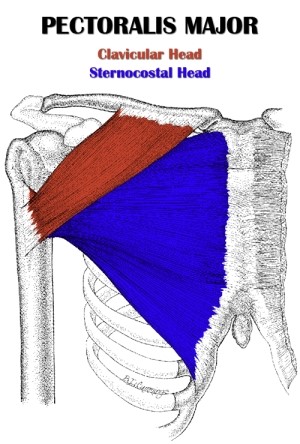
The pectoral muscle has two functions besides bringing your arms together like a dumbbell fly.  The pectorals also flex and extend the arm. There are two different sections of the pectorals that accomplish this. The sternal head helps extend the shoulder and the clavicular head helps flex the shoulder.
pectorial


Since my pain was mostly with flexion and horizontal Adduction, it was easy to tell that the clavicular head was more at fault. Looking at where the clavicular head attaches makes it easy to see why it is hard to diagnose with so many things attaching to the anterior side of the upper Humerus.  The deltoid/biceps/subscapularis/bursae/labrum are all possibilities that could create anterior shoulder pain. Also it is easy to see why the AC joint was irritated with the clavicular head attaching on the clavicle.  ON the next post I would like to discuss helpful positions that help diagnosis it.

Overhead squat and Early Extension in the Golf Swing.


When evaluating my inability to keep my hips back during the golf swing, also called early extension, I mentioned in my last post that Titleist was able to predict this in their movement screen. The Titleist movement screen goes through 13 different movement assessments. One movement assessment I did not pass was the overhead squat. This is a movement I have trained through my love of Crossfit, but I continue to have difficulty with the end-range form. However, the Titleist movement screen predicted that my inability to overhead squat would create early extension in my golf swing. I want to use this blog post to explore why inability to overhead squat would create early extension.

SCREEN 
In their screen they have taken 10,000’s of people’s score and found that the overhead squat correlated to early extension. TItliest has not answered the question, to my knowledge, as to why the overhead squat correlates to early extension. So let’s look at the overhead squat and figure out why it does.

fronning overhead squat

I believe the overhead squat predicted early extension mostly because of the inability to keep the weight centered over the feet during a dynamic upper and lower body activity. The golf swing is a very dynamic and precise lower and upper body activity so maintaining our center of mass is critical to developing efficient power. Early extension to me seems to be moving the center of mass forward onto the toes. There are a couple limitations in the overhead squat that could create forward leaning center of mass.

Limiting Factors 

Frist:The most limiting factor it seems in most squat activities are the ankles. I used to have lower back pain with squatting back in high school and college until I started to squat again with Crossfit. I soon found out the ankles were limiting my squat and causing my upper body to lean forward during the squat- creating more torque on the low back. Also previous ankle injuries from years of basketball created ankle issues and limited mobility. I never knew how much past injuries can still limit more complex movement skills like squatting and even running, but they continue to affect my ankle ROM and power.

Second:In the overhead squat if your arms cannot get straight overhead there is no way you can maintain an overhead squat. What limits this is years of Xbox, school work, reading, Ipad and any kind of rounded shoulder posture. How often do we get our shoulders overhead during the day? Not much. So another reason we fall forward during activity, is our upper body is pulling us forward just like when we sit at a computer.

Third: All of this correlates to inability to generate power. When I squat I tend to fall towards the ball of my feet and it’s no wonder I do the same in a golf swing. My brain has started to wire itself by generating power through my toes and getting to my toes as quick as possible instead of pushing through the arch of my foot. The overhead squat is looking at your ability to maintain trunk posture and generating power through your feet. The same is true in a golf swing.

The Proper Way to Rotate.

I recently attended a Titleist golf swing seminar and they emphasized the ability to rotate correctly for a proper golf swing. As a Physical Therapist,  I see the inability of people to rotate as a major factor for causing pain . Our bodies were meant to rotate without pain, but rotating with the wrong areas can lead to wear and tear and eventually “pain”.

Lets take a look at Rory MciIroy rotating.

rory gofl swing


We can safely assume that if he did not have the ability to rotate correctly while hitting a gazillion golf balls he would have pain.

Taking a look at this picture, lets take out the knees as a source of rotation since they don’t rotate anyway. Also, for the sake of argument, we will take out the ankles as a primary source of rotation. Although the ankles play a key role they do not rotate as much as some other areas need to.  Also, the arms look pretty straight and for the sake of argument lets say they play a more passive role than actively generating rotational power.

The chart below at the far right shows the amount of rotation for each spinal segment.


spine rotation


As we can see, the lumbar spine (L1-L5) does not have much rotation compared to other segments of the spine and shows less than 15 degrees of rotation. If you were to spread your middle finger and your ringer finger apart, the axis it would create is how much rotation you have from your low back. Take a look at the thoracic spine (T1-T12). A person should have around 50 degrees of rotation from your mid back/upper back. Looking back at the swing picture above, can you see how much rotation Rory is performing with his upper back? If he were to let his neck follow his upper back, he would be looking almost 90 degrees to the right.

Furthermore, let’s look at your hips. See how Rory is pivoting around his hips.  Your hips should rotate as well about 30-45 degrees depending on internal or external rotation of the hip. If we combine the thoracic spine and hips there should be almost 90 degrees of rotation and that is what is happening if Rory’s head followed his upper body. If you put your feet together and I ask you to rotate, can you get your shoulders square to the wall next to you? This is how much rotation you should be able to achieve.

Now imagine that as we sit all day at work and/or get older our hips tighten up and our rounded thoracic spine no longer rotates. What ends up happening? Our spine will end up rotating from the wrong areas and the next available area that will allow rotation is the lower back. The lumbar spine tends to be too mobile and will rotate if you allow it, but over time will wear down because it was not meant to rotate. This in turns causes degeneration and pain.

low back pain


Golf Swing, Early extension

I recently took a Titleist body-swing connection course and I wanted to share what I have learned about my swing. First, I want to take some slow motion pictures of my swing and interpret these through the big 12 swing faults according to Titleist.  I started playing golf as a teenager, however as my family has grown I am not able to play as often.  It’s not exactly ideal to be gone for 5 hours when you have 3 young kids that want to play with daddy.

My golf swing history within the last 5 years tends to be inconsistent with some pushes to the right or a larger draw. I used to fight a very bad shank and would try and correct it myself.  One way I attempted to fix it was by planting my left leg more or taking the club back more on the inside. I found that at times this would fix my shank but was very inconsistent. Eventually I realized that if I rotated my pelvis more through my downswing, I could avoid the shank.   If you watch the video below, you will see I may have fixed my shank but possibly left me more inconsistent with my swing, because I did not fix the real issue.

Below is what I believe to be the biggest swing issue causing my inconsistent golf game.  This swing fault is called early extension, which is part of losing your posture in the golf swing.  In the first picture, on the left, the line drawn is where my hips should stay during the downswing to make contact with the ball. On the right is where I am during the downswing.  Don’t get me confused with Tiger Woods to the far right.


As you can see from the video, my hips do not stay back on the line from which they came.  I am pushing my lower body into the ball and not allowing room for my arms.  If you take a look at Tiger Woods, you can see he does a much better job keeping his hips back.  Now, he hits billions of more balls than I ever have and plays every day but whose keeping track.  Returning to our conversation, I learned that a shank is not off the toe of the club but off the inside of the club. This swing fault does just that. It moves my club forward and puts the heel of the club on the ball – not allowing my arms to get through the ball.

The other thing I didn’t realize is how far inside I took the club during my back swing. This is seen in the first picture below.  The other fault I thought would be there is over the top. Over the top is a term used to describe when the club falls above the two parallel lines in the below picture.  I think I corrected this fault by turning my hips really well to get through the ball. It appears the club stays in the slot made by the two lines in the below picture.

In a subsequent post, I will take a look at the body swing connection and possible reasons I drive my weight forward during the golf swing based on movement faults the Titleist class breaks down.  I think it’s interesting what Titleist has done with their data and what I have learned.

MRI and Source of Pain?

First things first
Let’s talk about MRIs. After working as a PT in a Neurosurgery and Spine practice for several years, it is my experience that everyone wants to know what their particular MRI reveals. I think the more important questions are: do all patients need an MRI to identify a cause to their pain and does an MRI without a doubt show you what structure is at fault?
First off, I think it is important to understand that many asymptomatic(non-painful) individuals without back pain would likely have abnormal findings on an MRI of their spine. If you take a look at the chart below taken from a systematic review (Brinjikjia 2015) through Maitland (www.ozpt.com), you will see that not only as we age do we find more abnormalities on an MRI but also findings don’t necessary correlate to symptoms. Remember these are asymptomatic(people without pain) individuals and their findings.

Age (yr)

Imaging Finding     20       30        40       50       60       70       80

Disk degeneration   37%    52%    68%    80%    88%    93%    96%

Disk signal loss       17%    33%    54%    73%    86%    94%    97%

Disk height loss       24%    34%    45%    56%    67%    76%    84%

Disk bulge               30%    40%    50%    60%    69%    77%    84%

Disk protrusion        29%    31%    33%    36%    38%    40%    43%

Annular fissure        19%    20%    22%    23%    25%    27%    29%

Facet degeneration   4%      9%    18%    32%    50%    69%    83%

Spondylolisthesis      3%      5%      8%    14%    23%    35%    50%


It may even be appropriate to say that abnormal findings on MRIs of the spine are very common and can even be considered normal. Many times physicians and physical therapists use an MRI to more accurately find the source of your pain, however finding the actual source of pain can be more difficult than one would think.
I think it is safe to infer that we have likely a 50% chance of finding someone’s pain according to their MRI especially if the low back pain is very non-specific. MRIs alone are not sufficient to assess someone’s exact cause and location of their pain. The reality is a patient’s age, health status, other co-morbidities and location of their pain can be more reliable than an MRI alone.
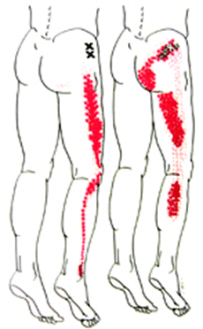
Guess what else your MRI doesn’t take into account? Pain generated from other areas like muscles, joints, ligaments, hip capsule, etc which can also cause referred pain around your spine. If you take a look at the picture below, you might think this patient’s pain is coming from sciatica. But guess what…this pain is from a gluteus medias trigger point and has nothing to do with nerves or your low back. It is important to rule out where the pain is NOT coming from to narrow down and diagnose the correct pain location.

picture

Lastly, patients tend to obsess over their MRI results, however this can actually cause prolonged recovery. An article by Flynn, Smith and Chou on Diagnostic imaging for low back pain says,
“The rate of lumbar spine magnetic resonance imaging in the United States is growing at an alarming rate, despite evidence that it is not accompanied by improved patient outcomes. Over-utilization of lumbar imaging in individuals with low back pain correlates with, and likely con¬tributes to, a 2- to 3-fold increase in surgical rates over the last 10 years. Furthermore, a patient’s knowledge of imaging abnormalities can actually decrease self-perception of health and may lead to fear-avoidance and catastrophizing behaviors that may predispose people to chronicity.”
I am not suggesting that there is not a role for Spine MRIs especially in patients with severe pain and radicular pain. However, we live in a culture where everyone wants a quick fix and even if the MRI does show exactly where your pain is the larger question is: how do we fix it?
More on this in a future post.